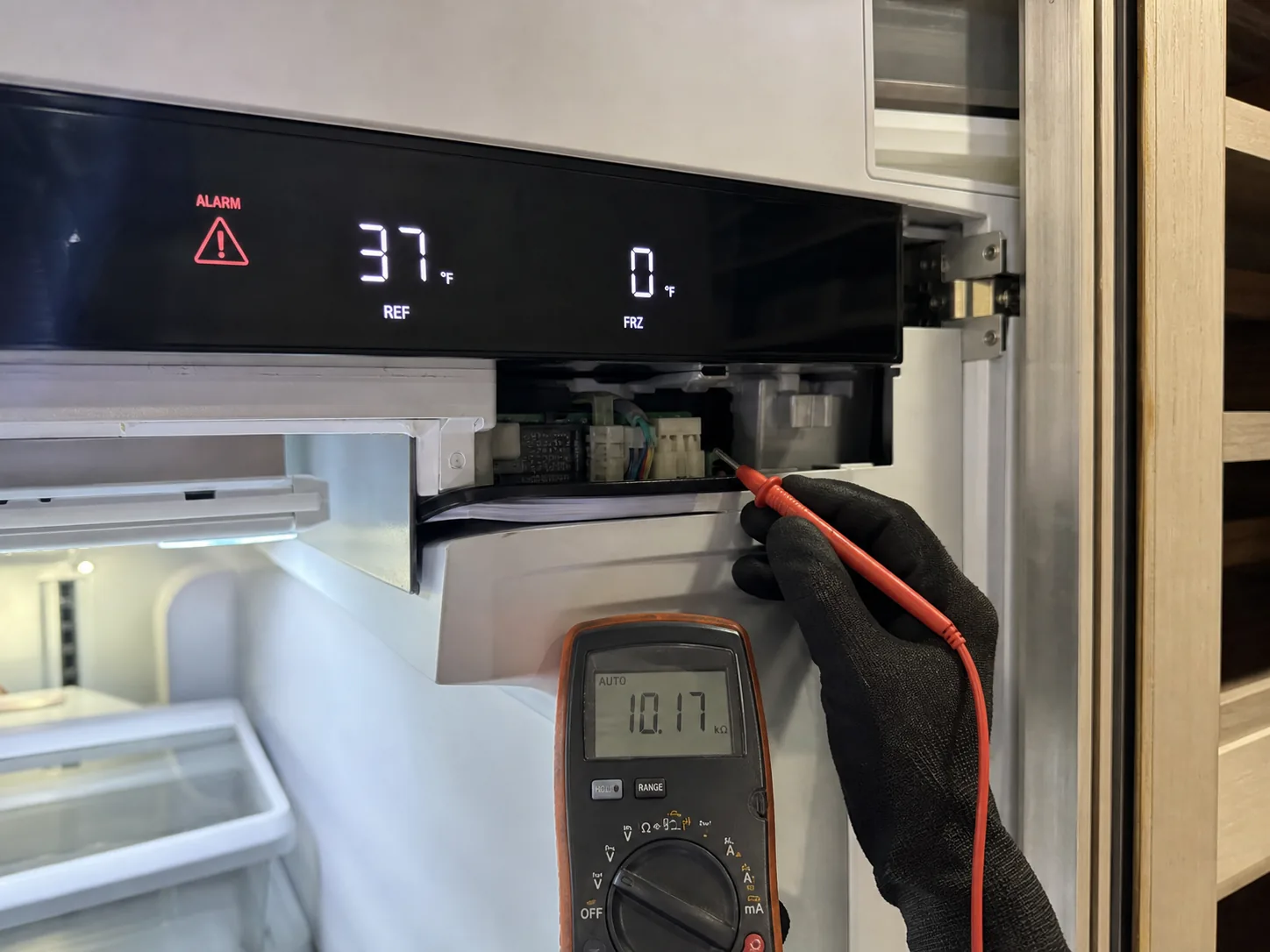
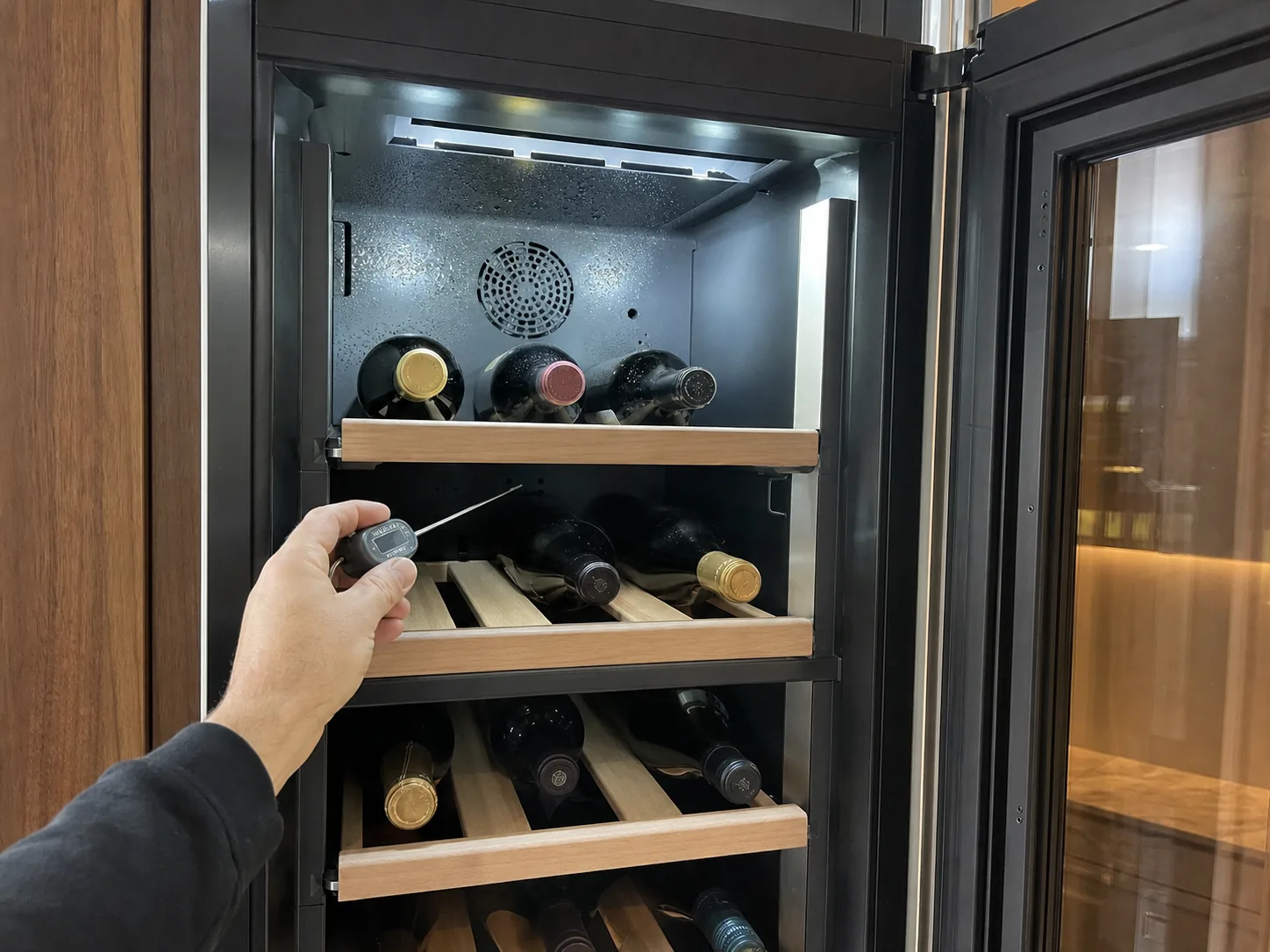
“Our built-in Sub-Zero was warming in the fresh-food section. The technician checked airflow first, found a weak evaporator fan, and had the cabinet protected the entire visit.”
Sub-Zero refrigeration · Menlo Park, CA
Your Sub-Zero stopped holding temperature. Here’s how we get it back.
We are a cold-side repair service for Sub-Zero built-in refrigerators, freezer columns and wine storage in Menlo Park. The problem we solve most is a built-in that drifts warm, frosts over or alarms — and answering whether it can be fixed in place without disturbing the cabinetry it was installed into. Around Sharon Heights, Stanford Hills and Allied Arts that means integrated panels, high-use kitchens and panel-ready columns, so we diagnose before we quote and schedule a specific window rather than a vague day.
The short version
In Menlo Park, specialists service Sub-Zero built-in refrigerators, freezer columns and wine storage across the Peninsula — from the wooded lots of Sharon Heights to the architect-built remodels around Stanford Hills and the bungalows of Allied Arts. Most repairs run $250–$900; sealed-system and compressor work on built-ins runs $1,000–$2,800 because it requires regulated refrigerant recovery. A flat diagnostic of about $110–$185 is credited toward any approved repair, and the exact price is confirmed in writing before work starts.
Direct answers
Direct answers for Menlo Park Sub-Zero owners
Who repairs Sub-Zero refrigerators in Menlo Park?
Meridian Pros of Menlo Park is a Menlo Park Sub-Zero repair resource focused on built-in refrigeration diagnostics, model verification, cabinet-safe access and symptom-specific repair planning. The most useful first evidence is the model tag, temperatures and a symptom photo.
How much does Sub-Zero repair cost here?
Published planning ranges separate the $110-$185 diagnostic, common $250-$900 fan/gasket/control/ice-maker work, and $1,000-$2,800 sealed-system work after confirmation. Compressor replacement should never be quoted before evidence. See the dedicated Menlo Park Sub-Zero repair cost hub for tables.
What should I check before requesting service?
Have model and serial details, fresh-food temperature, freezer temperature, alarm state, cabinet access notes and one clear symptom detail ready. These facts let the intake path separate a fan, gasket, ice maker, control, airflow or sealed-system suspicion before dispatch.
Can a technician service a built-in Sub-Zero without damaging cabinetry?
Cabinet-safe service starts with trim clearance, floor protection, water/electrical slack and whether the fault can be diagnosed without pulling the unit. Many fans, sensors, gaskets, ice maker parts and controls can be handled in place. A cabinet pull should be planned only after access and fault evidence justify it.
Start with the symptom
Find your Sub-Zero problem, then the right next step
Each tile says what the symptom usually means and what not to do before a technician sees it. These route to the diagnostic page that covers your exact failure.
Fresh food warm, freezer cold
Usually the fridge evaporator fan, a frosted coil or an air-damper fault on a dual-refrigeration unit.
Don’t keep opening the door to “help it cool” — it adds humidity and frost.
Not-cooling diagnosticIce maker slow or hollow cubes
Often the fill tube, inlet valve, water filter or a module/thermistor issue — rarely the whole assembly.
Don’t force the mold or chip stuck ice; you can crack the heater.
Ice maker & water lineWine column drifting degrees
Zone sensor, fan, door seal or control drift — a few degrees off is enough to worry a collection.
Don’t relocate bottles repeatedly; log the displayed temps first.
Wine storage driftCondensation, frost or seal leak
A gasket that has taken a set, a misaligned panel-ready door, or a defrost/humidity issue.
Don’t tape or trim a gasket; it changes the magnetic seal.
Gaskets & cabinet sealsError code or alarm light
The control has flagged a sensor, defrost or door condition — the code narrows it, the meter confirms it.
Don’t clear the code before noting it; the model number matters.
Error codes & alarmsBoth sides warm / compressor
Both compartments warming can be airflow, a condenser packed with dust, or a sealed-system fault needing EPA verification.
Don’t add a portable cooler against the unit; clear airflow instead.
Sealed system & compressorWhat the technician actually checks
Evidence, not adjectives
A correct Sub-Zero diagnosis comes from readings and parts you can see — temperature at the vents, the condition of the coil, and the model tag that tells us which component variant your unit uses.
How a visit runs
A diagnostic sequence, start to verification
We work the same order every time so nothing is skipped and you are not paying for trial-and-error part swaps. The goal is a confirmed cause and a firm number before any part is opened.
We do not guess on sealed systems. Refrigerant leaks, compressors and control boards are confirmed with instruments — pressures, continuity and temperature readings — before we recommend the most expensive repairs. If a fault cannot be confirmed on the first visit, we say so rather than replacing parts hopefully.
Intake by symptom
You describe the behavior and have the model and serial details ready; we arrive with the likely parts for that model family.
Confirm model & serial
The tag tells us the exact evaporator, board and gasket variant — Sub-Zero parts are not interchangeable across series.
Read before opening
Compartment temps, airflow at the vents and condenser condition come first, so we test the cheap causes before the costly ones.
Verify the part
We confirm the failed component with a meter or pressure check rather than swapping by guess.
Quote, then repair
You get a flat number in writing. Approve it and we fit the OEM part, documenting model, serial and parts on the invoice.
Verify the fix
We re-read temperatures and confirm the unit holds before we leave, and reseat any pulled built-in to its original panel alignment.
Before you replace it
A built-in Sub-Zero is usually worth repairing
Replacing a built-in or integrated Sub-Zero is not just the price of the appliance — it is cabinetry modification, panel refitting, water-line and electrical work, and often a remodel-grade disruption to a Menlo Park kitchen. A 20-year Classic or 600-series unit with a failed fan, board or gasket is normally far cheaper to repair than to replace.
The honest exceptions are real: a failed compressor on a very old unit, a discontinued part with no OEM substitute, or repeated sealed-system leaks. We will tell you when replacement is the better spend rather than selling a repair that won’t hold. See the full framework with scored criteria and local scenarios on the decision page.
Open the repair-vs-replace framework
Make the visit faster
What to have ready before we arrive
Have the model & serial ready
Use the tag (usually behind the grille, on an upper interior sidewall or inside the door) to pre-select the correct parts for your series.
Note the symptom
A display code, frost pattern, water pooling note or temperature reading is more useful than a vague description.
Note the temperatures
Put a thermometer in each compartment for an hour and write down what it reads versus the set point.
Clear the access path
Empty perishables you can, and clear the area in front so a built-in can be reached without moving fragile items mid-visit.
Don’t reset before diagnosis
Avoid unplugging or clearing alarms right before the visit — an active fault is easier to confirm than an intermittent one.
Have the install history
If the unit was relocated, re-paneled or serviced before, that context helps explain cabinet-fit and recurring faults.
Documented, model-matched service
What we document on every job
We are a refrigeration service that concentrates on Sub-Zero rather than every brand, because dual-refrigeration and sealed-system designs reward technicians who see them weekly. We don’t promise same-day to everyone — we confirm a realistic window when you book. The evidence we leave behind is the proof: temperature readings, the parts we replaced, and a unit that holds.
Go deeper
Guides for your exact Sub-Zero issue
Service area
Menlo Park & the Peninsula
We route by neighborhood — Sharon Heights, Stanford Hills, Allied Arts, Felton Gables, Central and West Menlo Park — plus Atherton, Palo Alto and Woodside.
Common questions in Menlo Park
Answers before you call
My fresh-food side is warm but the freezer is still cold — what does that mean?
On a dual-refrigeration Sub-Zero the fridge and freezer have separate evaporators and fans, so a warm fresh-food section while the freezer holds usually points to the refrigerator evaporator fan, a frosted-over fridge coil, an air-damper fault or a thermistor reading out of range — not the compressor. We confirm it with temperature readings at the vents and a look at the coil before quoting any part.
How much does Sub-Zero repair cost here?
Most Sub-Zero repairs in Menlo Park run $250 to $900 for fan, defrost, gasket, control or ice-maker work. Sealed-system and compressor repairs are the exception at roughly $1,000 to $2,800 because they require regulated refrigerant recovery and recharge. A flat diagnostic of about $110 to $185 is credited toward any repair you approve, and the exact price is confirmed in writing after diagnosis.
Do you have to pull the unit out of the cabinet?
Often not. Many repairs — evaporator fans, thermistors, ice makers, gaskets, control boards — are done with the unit in place. When a condenser deep-clean or a sealed-system repair does require pulling a built-in, we protect the surrounding millwork and flooring and reseat the unit so panel gaps stay correct.
Which neighborhoods and ZIP codes do you cover?
All of Menlo Park, including Sharon Heights, Stanford Hills, Allied Arts, Felton Gables, Central Menlo Park and West Menlo Park across 94025 and the 94027 Atherton border, plus nearby Palo Alto, Woodside and Redwood City. We route by neighborhood so access for wooded-lot homes or tight remodel kitchens is planned before arrival.
Call or book with your symptom and model number ready
Have the display code, frost pattern, temperatures and model tag ready when you call or book so the visit can be routed with the likely parts in mind.
Local reviews
Menlo Park homeowners who needed Sub-Zero help fast
Local feedback on model-first diagnosis, clean built-in work and written pricing.
138 local reviews
“I liked that the price was written out after diagnosis. The gasket was replaced cleanly, the panel gaps still looked right, and the refrigerator held temperature overnight.”
“They asked for the model tag before dispatch and arrived with the right part. No guesswork, no pressure to replace an expensive built-in.”