Evidence-first Sub-Zero intake across Menlo Park Menlo Park & San Mateo County · Mon–Sat 7am–7pm · (650) 699-5567 · Book Online 4.9/5 on Google · 138 local reviews
Meridian ProsSub-Zero · Menlo Park

Diagnostic guide · Not cooling

Sub-Zero not cooling in Menlo Park: warm fridge, warm freezer, or both

Start by reading both compartments. On a Sub-Zero, a warm fresh-food side with a cold freezer, both sides warm, or a freezer that’s slipping each point to different parts — so the first move is triage by compartment, not panic about the compressor. For a built-in in 94025, this also decides whether a cabinet pull is even on the table: a built-in cabinet removal/reseat is only needed for deep condenser or sealed-system work, not for a fan or sensor.

If both sides are warming together, the most common cause we find is a condenser coil packed with dust or pet hair choking heat exchange — cheap to fix and easy to miss behind a tight grille. What a diagnosis confirms, and what can’t be known from the front, is whether airflow alone is the problem or the sealed system is involved; those look identical until the coil is inspected and pressures are checked.

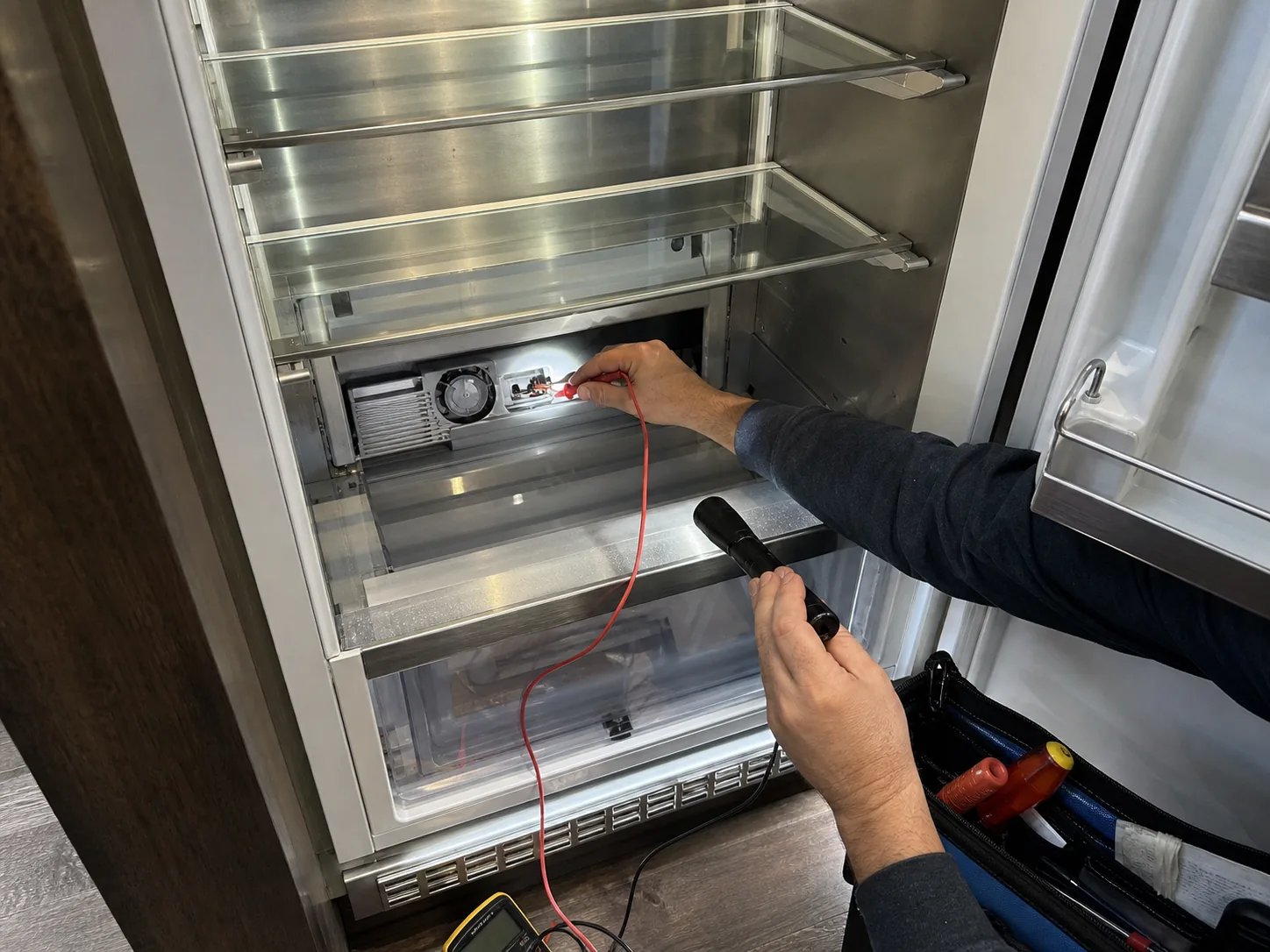
Technician checking fresh-food temperature with a probe inside a built-in refrigerator
Triage by compartment: vent and compartment readings separate a fan or coil problem from a sealed-system fault.

Normal vs. not normal

What “not cooling” actually looks like

A healthy Sub-Zero fresh-food section sits around 38–40°F and the freezer near 0°F, with the compressor cycling rather than running nonstop. Brief warming after a big grocery load or a long door-open is normal and recovers within hours. Not normal: a fresh-food side climbing past the mid-40s while the freezer stays cold, both compartments warming together, frost building where it shouldn’t, or the unit running constantly without reaching setpoint. If perishables are at risk and the unit is running hot to the touch at the grille, clear the condenser area, stop adding load, and book a diagnosis — continuing to run a starved system can turn a cheap repair into an expensive one.

Ranked, simple to expensive

Why a Sub-Zero stops cooling

  • Condenser coil packed with dust or pet hair

    Signs
    Both sides slowly warm, grille area hot, unit runs constantly.
    Test
    Inspect coil behind the grille; check airflow.
    Repair
    Deep clean and airflow restoration — often the whole fix.
  • Evaporator fan or frosted fridge coil

    Signs
    Fresh-food warm, freezer still cold (dual-refrigeration split).
    Test
    Meter the fan; inspect the fridge evaporator for frost.
    Repair
    Fan motor or defrost service after confirmation.
  • Thermistor / air-damper fault

    Signs
    One compartment off setpoint, display may look fine.
    Test
    Meter the sensor; check damper operation.
    Repair
    Sensor or damper part.
  • Door gasket leak, condensation or frost line

    Signs
    Warm air drawn in, unit overworks, sweating door.
    Test
    Paper-pull seal test; check alignment.
    Repair
    OEM gasket and door alignment.
  • Sealed system / compressor

    Signs
    Both sides warm, clean coil, unit runs but won’t cool.
    Test
    qualified pressure test — never assumed.
    Repair
    Sealed-system work; see the dedicated page.

We will not guess the sealed system. A warm-but-running unit is far more often airflow or a fan than a compressor. We confirm with the coil inspection and pressures before recommending the most expensive repair.

Local context

Cooling failures around Menlo Park

In Sharon Heights, wooded-lot homes mean more pollen, dust and pet hair drawn into the condenser, so coil-clogging is one of the most common “not cooling” calls we get there — and one of the cheapest to fix once diagnosed. Out toward the 94027 Atherton border, larger estate kitchens often run dual built-ins, and a single warm unit in a row of identical doors needs the serial to match the right parts. Across these homes the built-in installation is the constant: the unit is boxed into cabinetry, so airflow at the grille is easy to choke and easy to overlook without pulling the lower panel to look.

What the technician checks

Readings that separate cheap from costly

The proof for a cooling diagnosis: temperature readings at each vent, condenser and evaporator photos, model-tag proof, and the OEM fan, gasket or control-board part fitted. The same evidence that catches a door gasket leak, condensation or frost line catches a starved condenser.

Technician metering an evaporator fan inside a built-in refrigerator
Close-up: the failed part is confirmed by meter, then matched OEM by serial.
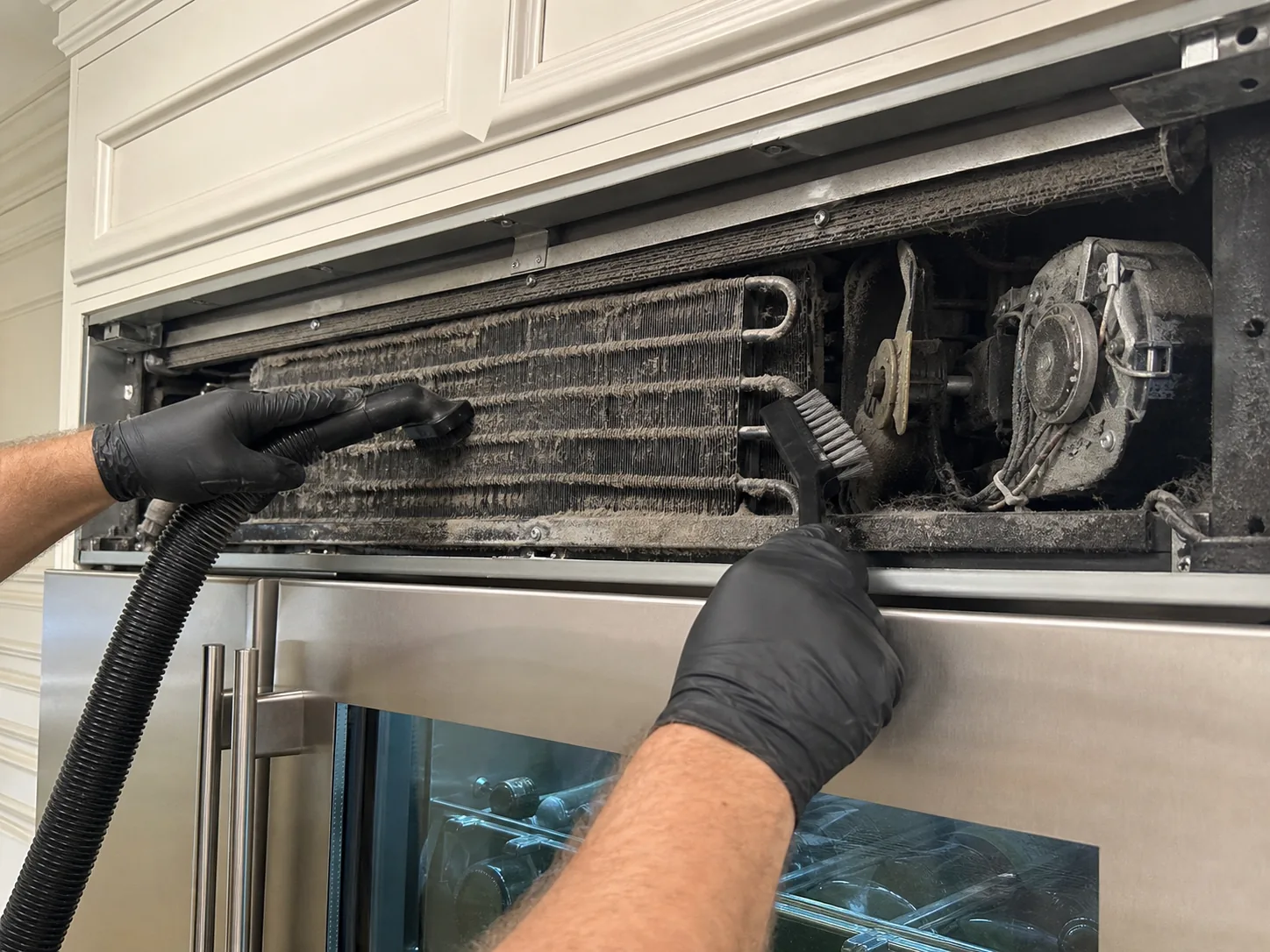
Technician cleaning a dusty built-in refrigerator condenser coil
Wider context: a built-in’s grille airflow is the first suspect when both sides warm.
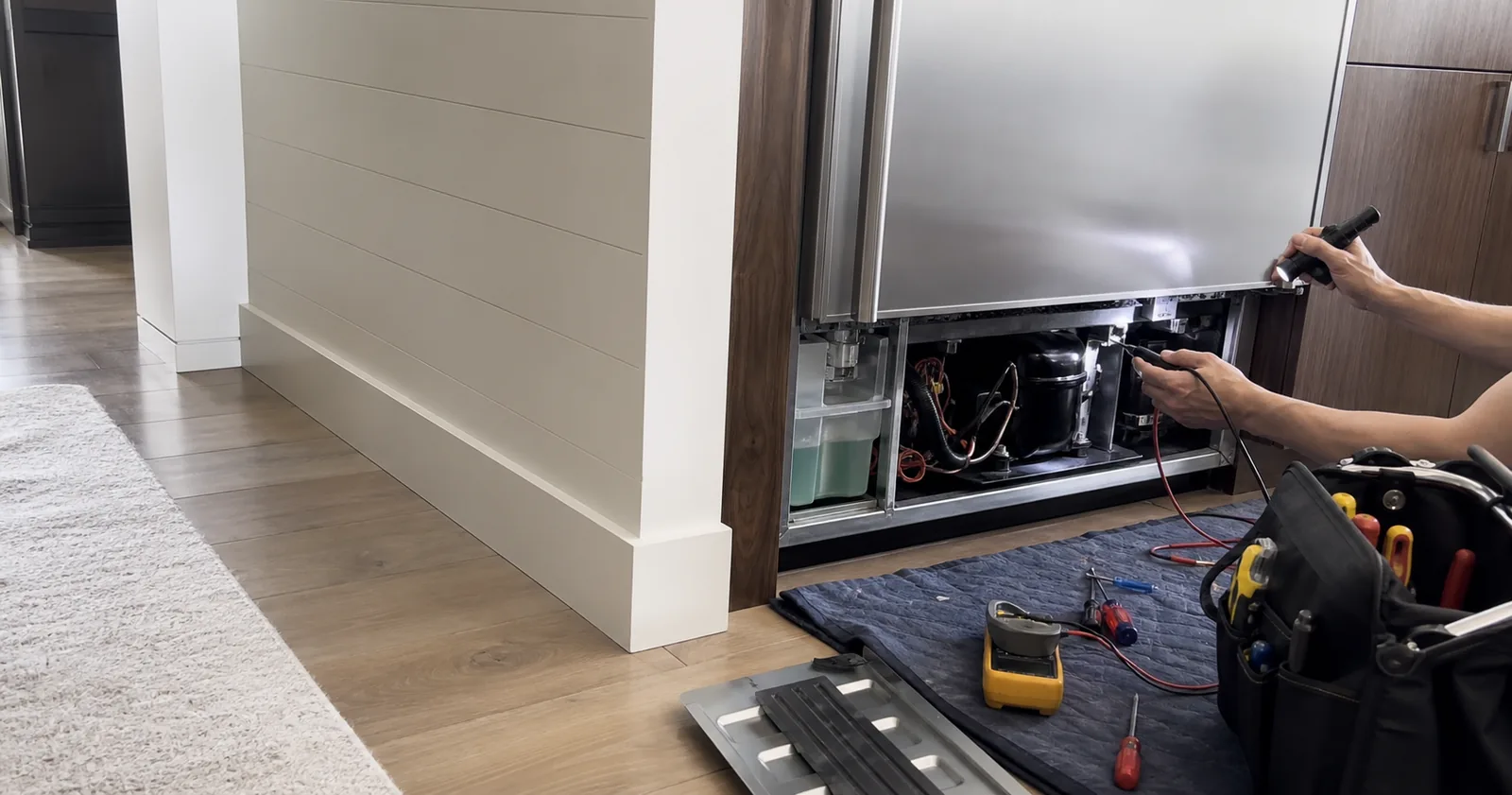
Technician accessing the lower sealed-system compartment of a built-in refrigerator
Tight integration traps dust at the condenser — common, and cheap to correct.

Before you book · 6 steps

Triage your Sub-Zero that stopped cooling

Two minutes of readings tells us — and you — whether this is a fan, a dirty coil or a sealed-system call before anyone is dispatched in Menlo Park.

  1. Read both compartments with a separate thermometer

    Put an independent thermometer in the fresh-food section and another in the freezer, wait 15 minutes, and write down both numbers. Healthy is ~38°F fresh-food and ~0°F freezer; do not trust the door display alone.

  2. Note which compartment is failing

    Decide the pattern: fresh-food warm while freezer stays cold, both compartments warm, or freezer warm while the fridge is cold. On a dual-refrigeration 642 or BI-36 this single fact splits the fault away from "new compressor."

  3. Check the condenser grille airflow and clearance

    Look behind the lower grille for a dust- or pollen-packed condenser and feel whether the grille area is running hot. In hillside Sharon Heights homes during a heat wave a choked coil is the top cause of both sides warming.

  4. Do not keep opening the door

    Stop opening the door and stop adding warm groceries. Every door-open dumps heat and humidity into a unit that is already struggling, which can turn a cheap airflow fix into a frosted-coil or starved-system repair.

  5. Photograph any alarm or error code

    If the control panel shows a not-cooling alarm or an error code, photograph it along with the temperatures you recorded. The code plus your two readings often points straight to the failed sensor, fan or defrost part.

  6. Book with your model tag and temperatures

    Find the model and serial tag (often inside the fresh-food door or upper-left wall) and book online or by phone with the model number plus both compartment temperatures. That lets us pre-stage the right OEM fan, sensor or gasket for Menlo Park.

Quick fact. A Sub-Zero fresh-food compartment holds ~38°F; if it drifts above ~45°F while the freezer stays near 0°F, the fridge evaporator fan or defrost is the usual cause, not the compressor.

Symptom -> likely cause -> price -> time

Menlo Park Sub-Zero not-cooling: symptom-to-cost table

SymptomLikely causePlanning rangeTypical time
Any not-cooling call (first visit)Diagnostic visit, credited toward the repair$110–$19545–75 min
Fresh-food warm / freezer coldFridge evaporator fan or frosted coil$300–$6201–2 hr
Fresh-food warm / freezer coldAir damper or thermistor fault$240–$5401–2 hr
Both compartments warmCondenser packed with dust / blocked airflow$190–$4601–1.5 hr
Both compartments warm, coil cleanSealed-system / compressor (verified by pressures)$1,050–$2,8004–8 hr
Freezer warm / fridge coldDefrost system (heater, sensor or timer)$320–$7201.5–3 hr
Ice / frost buildup on the coilDefrost service plus airflow restoration$300–$6801.5–3 hr

In premium Menlo Park kitchens (94025/94027) most not-cooling calls land in the $190–$720 airflow-or-part range; a verified sealed-system repair is the rare high end, never the default quote.

Not-cooling questions

Six questions about this symptom

My fridge is warm but the freezer is fine — is that the compressor?

Almost never. On dual-refrigeration Sub-Zeros the fridge and freezer cool separately, so a warm fridge with a cold freezer points to the fridge evaporator fan, a frosted coil or a sensor/damper fault. We confirm with vent readings before quoting.

Both sides are warming — what's the most likely cause?

A condenser coil packed with dust or pet hair, choking heat exchange. It's common in built-ins and one of the cheapest fixes once diagnosed. A sealed-system fault can look the same from the front, so we inspect the coil and check pressures to tell them apart.

Can I keep using it until you arrive?

If perishables are at risk and the unit runs hot, clear the condenser area and stop adding load. Running a starved system can worsen the failure, so book promptly rather than waiting it out.

Is a not-cooling Sub-Zero worth repairing?

Usually yes — most are a fan, coil, sensor or gasket, far cheaper than replacing a built-in. The honest exception is a failed compressor on a very old unit; see our repair-vs-replace framework.

Does a Menlo Park summer heat wave make my Sub-Zero stop cooling?

It can tip a marginal unit over. When Sharon Heights hillside homes hit the low 90s°F, condenser load spikes, so a coil already half-choked with pollen can no longer reject heat and both sides drift warm. A deep condenser clean ($190–$460) usually restores setpoint without any sealed-system work.

My BI-36 freezer is cold but the fridge is warm — is the compressor dead?

Very unlikely on a dual-refrigeration BI-36. Separate evaporators and fans cool each compartment, so a cold freezer proves the compressor and sealed system are working. The warm fresh-food side is almost always the fridge evaporator fan, a frosted coil or a thermistor/damper — a $240–$620 repair, not a compressor.

Check whether repair makes sense before replacing

Read both compartments, have the numbers and your model tag ready, and we’ll tell you the likely cause — and whether it’s worth repairing.

Local reviews

Recent Menlo Park Sub-Zero service reviews

Local feedback on model-first diagnosis, clean built-in work and written pricing.

4.9/5 Google rating
138 local reviews
★★★★★

“During a July heat wave our 642 fresh-food side climbed to 46°F while the freezer held at 0°F. In our wooded Sharon Heights hillside home the condenser was packed with pollen and the fridge evaporator fan had quit. Fan replaced, coil cleaned, back to 38°F in about 90 minutes — no compressor.”

Evan B.Sharon Heights · Sub-Zero 642 owner
★★★★★

“Both compartments on our BI-36 were drifting warm — fridge near 48°F, freezer up to 18°F. Our 1920s Stanford Hills kitchen had the built-in boxed tight, so airflow at the grille was choked with dust. A deep condenser clean ran $215 and the unit was holding setpoint within two hours.”

Maya L.Stanford Hills · Sub-Zero BI-36 owner
★★★★★

“Our Linfield Oaks bungalow BI-36 had the freezer warming to 22°F while the fridge stayed cold — a frosted-up defrost system. The tech read both compartments, found the failed defrost heater, and replaced it for $410. Done the same afternoon and freezer was back near 0°F by morning.”