
Wine storage · 6 min read
Why a Sub-Zero wine column drifts warm in Menlo Park
A Sub-Zero wine column that creeps warm or loses its second zone is usually fixable. How dual-zone drift, a tired sealed system and a leaking seal show up in Menlo Park cellars.
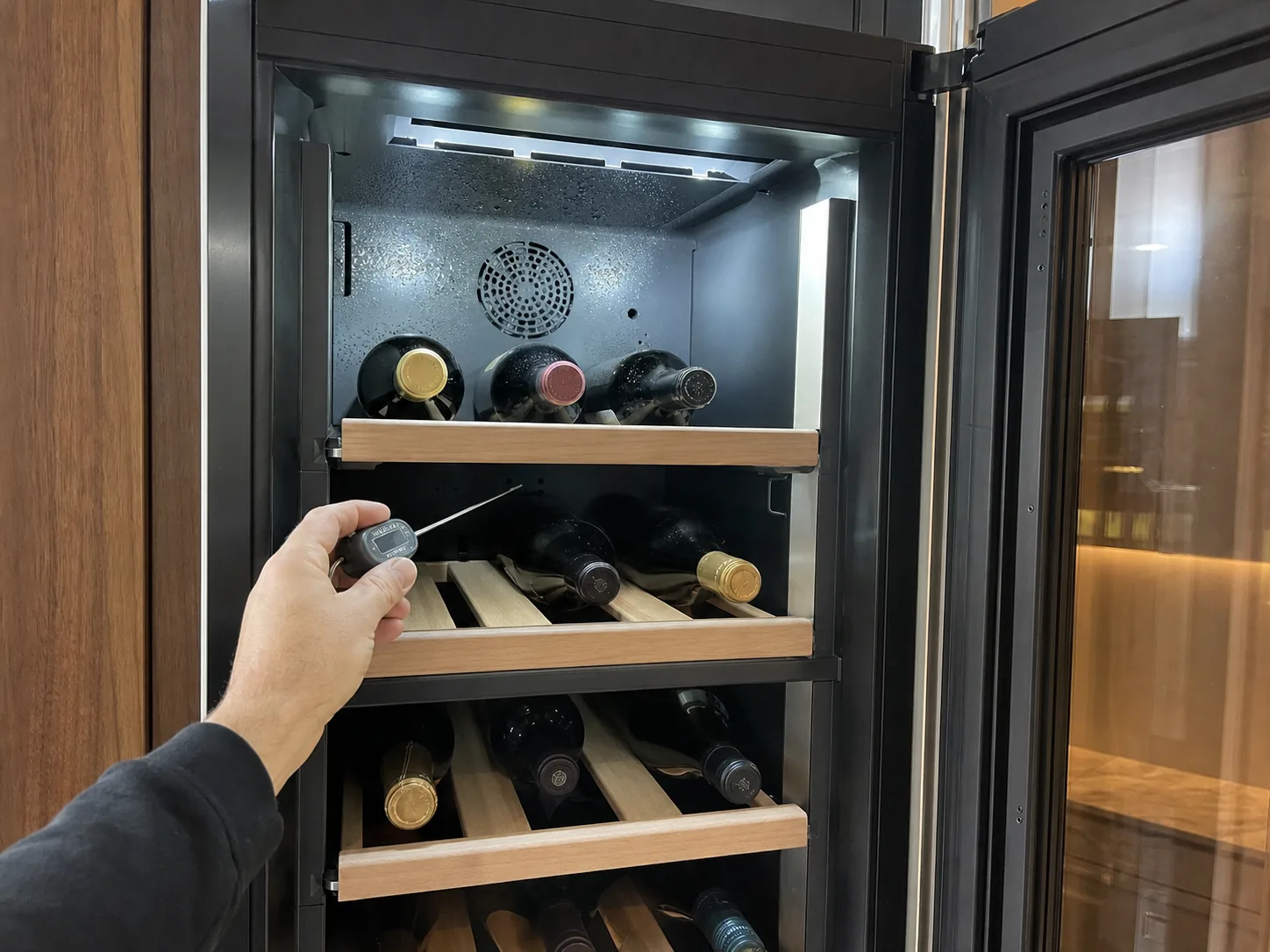
A serious Menlo Park collection is rarely in a basement — it lives in a built-in Sub-Zero wine column in the butler's pantry off the kitchen, or recessed into a bar wall in an Allied Arts remodel. Sub-Zero has built dedicated wine storage for years, and the engineering goal is the opposite of a beverage fridge: hold one or two zones rock-steady, with no vibration and no UV, so a Burgundy laid down today is still right in a decade.
When that steadiness slips — the upper zone creeps from a cellar 55°F toward the low 60s, or the two zones converge to one temperature — owners notice fast, because the whole point of the cabinet is that nothing should change.
Dual-zone drift and the sensor behind it
Most of the wine columns we see in Menlo Park are dual-zone: a cooler upper compartment for whites and sparkling, a warmer lower one for reds, each governed by its own thermistor and damper. The fault that brings us out most often is one zone losing its setpoint while the other holds. That asymmetry is the tell — it points at a failing zone sensor or a stuck damper feeding bad data to the control, not at the refrigeration as a whole.
When both zones drift warm together, the story is different and usually points downstream at airflow or the sealed system. We read the actual cabinet temperatures against the displayed setpoints before touching anything, because a wine column that is two degrees off is a calibration or sensor job, while one that has lost a whole zone is something else.
Airflow, the sealed system, and the heat Menlo Park adds
A wine column rejects its heat through a condenser behind the lower grille, and in our climate that grille has a hard summer. Menlo Park afternoons warm up, butler's pantries get little air movement, and the oak pollen that coats everything from Felton Gables to west Menlo settles into the coil. A blanketed condenser makes the compressor run long and the cabinet drift warm in the heat of the day — and clearing it is often the entire fix.
If the coil is clean and the cabinet still cannot hold temperature, the next layers are the evaporator fan that moves cold air across the bottles and, at the far end, the sealed system itself — a refrigerant leak or a tired compressor. That is the expensive diagnosis, and on a wine cabinet it is worth gauges and a real pressure reading before any verdict, because the rest of a Sub-Zero column is built to outlast it.
The seal, the glass, and the quiet that protects sediment
Two things unique to wine storage are easy to overlook. The door carries a UV-tinted glass panel and a perimeter gasket; when that seal hardens or the door sags, warm room air and daylight both leak in, and a column near a sunny Menlo Park window will fight a losing battle until the gasket is replaced. And the compressor mount matters more here than on a kitchen fridge — a worn mount or an unbalanced fan transmits a faint, constant vibration that, over months, disturbs the sediment in older reds. If your bottles hum when the unit cycles, that is a repair, not a quirk.
None of these is a reason to replace the cabinet. A gasket, a sensor, a fan, a condenser clean — these are bounded, well-stocked parts on a unit built to run two decades, and they are backed by our 365-day warranty on parts and labor. We would only raise replacement on a much older column facing a full sealed-system rebuild, and even then we would show you the numbers first. Call (650) 699-5567 or book online and we will bring the common Sub-Zero wine-cabinet parts on the first visit.
FAQ
Questions & answers
My Sub-Zero wine cooler's two zones now read the same — is that fixable?
Usually yes. When one zone loses its setpoint while the other holds, the cause is typically a failing zone sensor or a stuck damper, both bounded parts. We confirm by reading the real cabinet temperatures against the setpoints before replacing anything.
Why does my wine column run warm only on hot afternoons?
That pattern almost always points to the condenser. In Menlo Park, pollen and a still butler's pantry let the lower grille coil load up, so the compressor can't shed heat on a warm day. A condenser clean is often the whole repair.
Is a faint vibration from the cabinet a problem for my wine?
It can be. A worn compressor mount or unbalanced fan transmits a constant low vibration that disturbs sediment in older reds over time. It is a straightforward repair rather than something to live with.
Rather leave it to a specialist?
Call or book with your model number and symptom ready, and we will route the visit with the likely parts in mind.